Taking client projects from requirements to delivery.
Freelance work through Upwork gave me direct responsibility for understanding client needs and turning them into working software. I delivered frontend and full-stack projects for clients across industries, using React, JavaScript, TypeScript, Node.js, and REST APIs.
Explore this chapter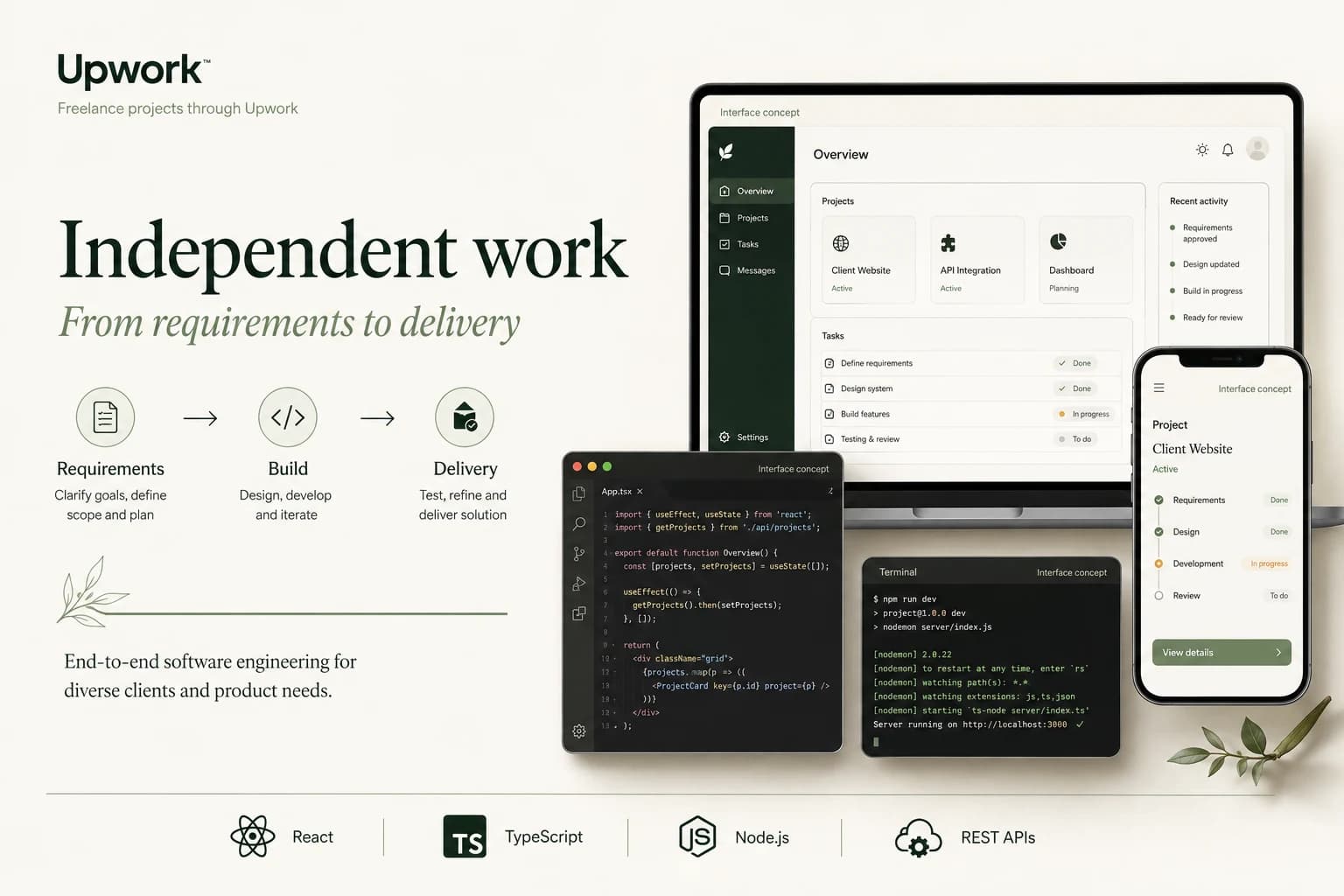
Learning to own the whole delivery
I worked directly with the people commissioning each project. That meant the engineering started with conversation and requirements, then continued through implementation and deployment. I needed to understand what a client expected the software to do and translate that into work I could deliver.
The projects helped establish my approach to architecture. I had to choose how to organize an application, connect it to services, and keep it understandable beyond the first implementation. Performance and reliability were practical concerns throughout the delivery process.
What I worked on.
Requirements and technical scope
I worked with clients to translate business requirements into technical solutions. Taking responsibility for that translation helped me connect requested features to application behavior and clarify the work needed before implementation.
Frontend and full-stack implementation
I delivered React and TypeScript projects alongside full-stack work with Node.js and REST APIs. I handled the connection between interface behavior and application data, with attention to frontend structure, performance, and reliability.
Delivery through deployment
I led the development lifecycle through deployment. That extended my responsibility beyond individual screens to the completed application and required me to keep technical decisions aligned with the agreed project requirements.
How I work.
Make the requirement concrete
I used direct client conversations to understand the intended result. Translating an idea into application behavior made the work easier to reason about and gave implementation decisions a clear purpose throughout the project.
Keep architecture proportionate
I focused on frontend structures that could support the project and remain understandable as it changed. Working across requirements, implementation, and deployment helped me weigh technical decisions against the needs of the whole delivery.
Skills I developed.
Client communication
I learned to ask clearer questions and explain technical choices in relation to client needs. Working directly with clients made that communication part of the engineering work every day.
End-to-end ownership
Managing the lifecycle developed my ability to follow a requirement through application structure, implementation, and deployment. It gave me an early foundation for the broader responsibilities I later took into product teams.
Frontend and backend connections
Full-stack projects strengthened my understanding of how interfaces depend on APIs and server-side behavior. That perspective continues to inform how I approach frontend architecture and discuss system design with other engineers.
Tools of the work.
- React
- JavaScript
- TypeScript
- Node.js
- REST APIs