javascript / nodejs / event-loop / tooling
JavaScript Event Systems and File Watchers
File watchers are event producers on top of the host event loop: changes are detected, queued, and delivered asynchronously—never by busy-waiting in JavaScript.
In this article
A brief outline
Reading lens / reliability
Notifications are hints, not a ledger
- Detect
The host or runtime observes a filesystem signal.
- Coalesce
Normalize storms before they become expensive work.
- Deliver
Run a bounded listener and reconcile for correctness.
A small experiment
Two saves. Read what is there now.
Try a watcher pipeline that combines repeated notifications for the same file.
Application queue
No pending hints
Read callback
waitinghas not read the fileThe file contains version 1. This example starts with no pending notification.
Opening answer
A file watcher in JavaScript is not a tight loop that polls stat forever inside your source. It is an event producer: the runtime (or a native binding) observes filesystem activity, then delivers change notifications through the event loop as asynchronous callbacks or stream events.
If detection happens in native code, delivery still lands on the JS thread as a turn of the event loop—just like timers, network I/O, and promise reactions.
Two layers people conflate
1. Detection
Operating systems expose different notification mechanisms. Node’s fs.watch documents that behavior is platform-dependent: availability, recursive options, and event granularity vary.
Some tooling falls back to polling when native events are unreliable. Polling is still asynchronous from the application’s perspective—it schedules checks, it does not block the event loop with a busy spin in well-written libraries.
2. Delivery
Regardless of detection strategy, your listener runs as event-loop work:
filesystem / native watcher
        ↓
libuv / host I/O callback
        ↓
JS event loop turn
        ↓
your listener / pipeline
Browser JS uses a related event-loop model for tasks and microtasks (MDN — The event loop). File watching is primarily a server/tooling concern, but the same “don’t block the loop” discipline applies.
Why watchers feel flaky
Real systems hit these issues often:
- Event storms — saving a file may emit multiple events (rename + change, editor atomic saves, linters rewriting files).
- Missing events — platform limits, recursive watch gaps, or network filesystems.
- Ordering surprises — “unlink then create” vs “change” depends on the editor and OS.
- Permission and symlink edges — tools that follow links may watch more than you intended.
Production pipelines therefore debounce, coalesce by path, and treat notifications as hints to re-check state, not as a perfect ledger of history. An event-triggered check cannot discover a notification that never arrived: correctness-critical tools also need periodic full reconciliation or an explicit source-of-truth scan at checkpoints.
A resilient pipeline shape
watch events
  → normalize path
  → debounce / coalesce
  → verify with stat or content hash (optional)
  → enqueue work
  → process with concurrency limits
  → report errors without crashing the watcher
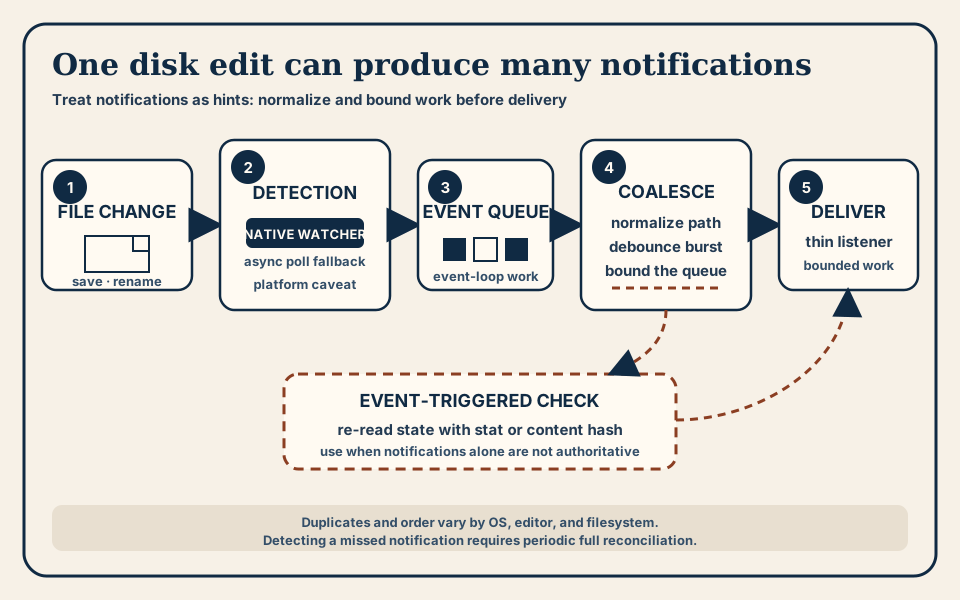
The diagram’s solid path is the ordinary delivery flow: detection produces event-loop work, the queue absorbs the notification, coalescing collapses redundant paths, and a thin listener hands off bounded processing. The dashed event-triggered verification path checks current state after a signal. A separate periodic scan is required when the system must recover from missed signals.
Design rules
- Idempotent handlers — processing the same path twice should be safe.
- Bounded queues — unbounded event buffers become memory leaks under storms.
- Backpressure — if build work is slow, drop or coalesce redundant events.
- Explicit roots — watch the smallest directory set that meets the need.
- Periodic reconciliation — when missed events matter, rescan the watched root on a bounded schedule or at explicit correctness checkpoints.
Event loop hygiene
Node’s event loop phases (timers, I/O callbacks, poll, check, close, plus microtasks) are documented in The Node.js Event Loop. Watcher callbacks are I/O-driven work: long synchronous CPU inside a listener delays everything else on that thread—other I/O, timers, and incoming requests.
If change handling is expensive (compile, test, image pipeline), push it to:
- a worker thread / child process, or
- an async job queue with concurrency limits
Keep the listener thin.
Consolidating two overlapping mental models
Many explanations split “OS events” and “JS events” into separate stories. Operationally they chain:
- OS/native layer answers “did something change on disk?”
- JS event system answers “when does my code observe that fact?”
Treating them as one story avoids two common mistakes:
- Busy-wait polling inside application code “to be sure.”
- Assuming every disk mutation yields exactly one perfect callback with full diffs.
Practical checklist for tooling authors
- Prefer native watch APIs when available; document platform caveats from fs.watch.
- Debounce editor save storms.
- Reconcile against actual file contents for correctness-critical pipelines.
- Never do multi-second sync work in the listener.
- Surface watcher errors (EMFILE, permissions) instead of failing silently.
Takeaway
File watching is an event-driven integration with the host I/O system, delivered through JavaScript’s event loop. Build for imperfect notifications: coalesce, verify when needed, and keep listeners non-blocking. That model is more reliable than any single “perfect event” assumption—and it is the same discipline that keeps servers and developer tools responsive under load.